
Introduction: Driving Forward with Advanced Precision
The global automotive ecosystem is undergoing a massive paradigm shift. As manufacturers balance the demands of high-throughput assembly lines with stringent carbon-neutrality mandates, traditional heat-treatment technologies are falling short. Conventional gas-fired furnaces, which require hours to idle, radiate excessive ambient heat, and introduce massive dimensional distortion, are no longer viable options for a modern smart factory. To remain competitive, forward-thinking Tier-1 suppliers and OEMs are pivoting toward an advanced alternative: electromagnetic thermal engineering.
When analyzing how induction heating improves production efficiency in automotive component manufacturing, the immediate advantages center around precision, scalability, and extreme energy savings. Unlike obsolete convective systems that heat an entire room to warm up a part, the automotive induction heating process generates localized thermal energy directly within the structural matrix of the metal workpiece. This localized execution allows automotive lines to run at maximum output, ensuring every structural asset—from steering racks to complex transmission gears—meets strict microstructural tolerances. By deploying high-frequency electromagnetic fields, the modern automotive supply chain is successfully unlocking rapid processing velocities while eliminating unnecessary energy overhead.
Understanding the Mechanics: The Automotive Induction Heating Process
To fully grasp how electromagnetic fields replace open flames, it is necessary to examine the foundational physics governing this clean, contactless thermal method.
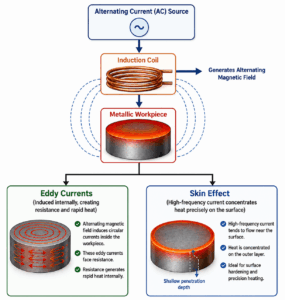
The underlying system relies on an alternating current (AC) passing through a custom-engineered copper inductor coil, which projects a highly localized alternating magnetic field. When an electrically conductive metal component passes through or rests inside this active magnetic field, it triggers a localized electrical phenomenon known as eddy currents.
Because every steel, iron, or aluminum alloy possesses an inherent electrical resistance, these rapidly oscillating eddy currents transform the electrical input directly into precise thermal energy through Joule heating. Furthermore, due to the high-frequency nature of modern induction power supplies, the thermal energy is constrained to the outermost boundaries of the metal via the “skin effect.” This specialized physical phenomenon enables deep or shallow thermal patterns depending on the selected kilohertz or megahertz frequencies. For a deeper breakdown of these electromagnetic parameters across diverse metal profiles, engineering teams often reference structural materials overviews, such as the ASM International Materials Information Database.
By focusing this energy exclusively within the precise target zone of the component, there is no thermal lag, no reliance on ambient air conduction, and zero burning of fossil fuels. This clean, controllable mechanism serves as the technological foundation for modernizing high-volume production floors.
Eliminating Bottlenecks: Cycle Time Reduction in Manufacturing
In any high-volume automotive production line, profitability is tied directly to takt time and operational throughput. Conventional thermal ovens represent a massive structural bottleneck because they require hours of non-productive preheating before an assembly shift can begin. Conversely, implementing induction heating for automotive components completely eliminates warm-up and cool-down cycles.
Instantaneous Heat Generation
An induction power system transfers energy to a metallic component instantly, often raising the component’s surface temperature to over 1000°C in less than a second. This rapid thermal deployment unlocks a massive cycle time reduction in manufacturing, dropping operations that previously consumed hours down to a matter of single-digit seconds. Because the process is entirely solid-state and instantly adjustable, the heating cycle integrates seamlessly with robotic pick-and-place arms and automated inline indexing systems.
Seamless Assembly Integration
Instead of transporting bulk bins of components across the facility to a dedicated, off-line heat treatment room, operators can position compact induction hardening scanners directly inside the machining and assembly cells. This continuous, single-piece workflow reduces work-in-progress (WIP) inventory buffer zones, limits component handling damage, and eliminates logistics bottlenecks, allowing raw steel forgings to evolve into completely machined, hardened components on a unified production line.
Engineering Superior Performance: Surface Hardening of Automotive Components
Automotive sub-assemblies operate under demanding operational environments characterized by constant cyclical stress, high rotational friction, and sudden torque loads. Consequently, structural components require specialized material characteristics: a highly wear-resistant outer shell combined with a tough, ductile core capable of absorbing sudden mechanical shocks without fracturing.
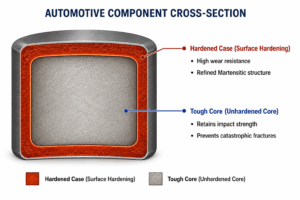
Achieving this delicate balance requires targeted surface hardening of automotive components. Conventional carburizing furnaces soak the entire part for hours, which frequently hardens the core unnecessarily, making the structural item brittle and prone to premature cracking.
Induction heating eliminates this operational vulnerability through ultra-precise frequency manipulation. By applying high frequencies, engineers restrict the primary heat-affected zone to a precise case depth, ranging from a few microns to several millimeters. The core remains unheated and unaffected, completely preserving its original impact strength.
This localized processing delivers substantial metallurgical advantages:
- Minimized Geometric Distortion: Because only a fractional percentage of the total mass undergoes thermal expansion and contraction, the part retains its strict geometric tolerances. This eliminates the need for expensive post-heat grinding, straighteners, and corrective machining processes.
- Scale-Free Surface Finish: The rapid heating cycles prevent prolonged exposure to oxygen at elevated temperatures, significantly mitigating surface oxidation and scale formation.
- Elimination of Hazardous Chemicals: The process completely removes the need for toxic salt baths or volatile gas atmospheres, significantly improving factory floor safety.
Case Studies in Powertrain: Crankshaft Induction Hardening & Gear Hardening Process
To truly evaluate how induction heating improves production efficiency in automotive component manufacturing, we must look at its application on key powertrain elements. The engine crankshaft and the transmission gearbox represent the two most critical torque-bearing assemblies in a vehicle, requiring specialized thermal solutions.
1. Crankshaft Induction Hardening
An engine crankshaft contains multiple complex geometries, including main journals, rod pin journals, and sharp counterweight transition fillets. Each journal surface experiences continuous friction against bearing shells, demanding localized high-hardness profiles.
Utilizing automated crankshaft induction hardening equipment, specialized clam-shell or split-inductor coils clasp around individual rotating journals. The system applies a localized burst of energy, followed immediately by an automated polymer quench spray. This rapid sequence converts the outer ferrite-pearlite matrix into a tough, wear-resistant martensitic crystal structure.
Because the heat is focused exclusively on the bearing paths and critical fillets, the internal core remains resilient, and the overall axial run-out of the shaft is kept well within single-digit micron tolerances. For global technical specifications detailing these advanced component requirements, Tier-1 engineering groups often cross-reference international standards via portals like the Society of Automotive Engineers (SAE International).
2. Gear Hardening Process
Transmission gears face a distinct mechanical challenge: the tip, face, and root of every single gear tooth must withstand continuous sliding wear and immense bending stresses. Standard furnace methods often overheat the thin tooth tips while leaving the critical root areas unhardened.
An optimized gear hardening process solves this challenge through simultaneous dual-frequency integration. By injecting a lower frequency (which penetrates deeply into the tooth roots) simultaneously with a high frequency (which targets the outer tips), the inductor generates a perfectly uniform contour case depth across the entire tooth profile. This balanced thermal application reduces operational wear, minimizes gear howling noises during vehicle operation, and extends the overall functional lifespan of the drivetrain assembly.
Material Excellence: Metallurgical Properties Improvement
Beyond simple operational speed, shifting away from a bulk heat treatment process in automotive industry models toward localized induction heating delivers exceptional metallurgical properties improvement.
When a carbon steel matrix is exposed to the rapid thermal incline rates characteristic of induction fields—often exceeding 200°C per second—the internal microstructure undergoes a rapid phase transformation into austenite. Because this transition occurs so quickly, the grain structure does not have the time or environmental conditions required to grow larger.
| Feature | Conventional Furnace Heat Treatment | Advanced Induction Heating Process |
| Heating Rates | Slow (Convective/Radiant) | Ultra-Fast (Electromagnetic Induction) |
| Grain Structure | Coarse grain boundaries; lower toughness | Ultra-fine, homogeneous grain matrix |
| Surface Oxidation | High scale formation; requires blasting | Minimal to zero scale; clean surface finish |
| Processing Scope | Bulk component heating (unselective) | Precise, localized depth configuration |
| Post-Process Rework | Heavy distortion; requires hard turning | High dimensional stability; drop-in ready |
Upon immediate quenching, this ultra-fine austenite structure transforms into an exceptionally fine, homogeneous martensitic layer. This highly refined grain structure yields significantly higher yield strength, enhanced fatigue resistance, and a more uniform surface hardness profile than traditional long-soak furnace operations can ever achieve.
Furthermore, this rapid processing approach provides superior control over structural steel variants. Whether managing specialized carbon steels, micro-alloyed compounds, or advanced ductile iron castings, modern induction systems can fine-tune output frequencies and power densities to perfectly match the transformation curves of each material profile. This precise metallurgical adaptability ensures that high-stress steering knuckles, drive shafts, and wheel hubs maintain maximum field reliability under all driving conditions.
Sustainable Modernization: Energy Efficient Heat Treatment Automotive Industry
In the modern manufacturing landscape, true operational efficiency must include environmental sustainability and optimized energy resource management. Traditional gas or fuel-fired industrial furnaces are inherently inefficient thermal systems, dissipating up to 60% of their total energy input into the surrounding factory atmosphere through shell radiation, exhaust stacks, and convective air losses.
Adopting an energy efficient heat treatment automotive industry framework relies on replacing these outdated, high-emission thermal systems with targeted electromagnetic induction. Because induction systems generate thermal energy internally via localized electrical currents, the process achieves a thermal transfer efficiency exceeding 85% to 90%.
Key environmental and operational advantages include:
- Zero Idling Consumption: Induction power supplies consume electricity only when a component is actively inside the coil undergoing heat treatment. There is no need to burn fuel during lunch breaks, weekend shutdowns, or line changeovers.
- Mitigation of Ambient Thermal Loading: Because there is no radiant heat escaping into the workspace, manufacturing plants realize a substantial drop in factory floor ambient temperatures. This significantly reduces the electricity costs required to run heavy facility air conditioning and ventilation systems.
- Direct Decarbonization Pathway: Shifting from fossil-fuel combustion to an all-electric power infrastructure allows automotive plants to run their entire thermal processing network using renewable energy sources like solar, wind, or hydro-power, directly supporting corporate net-zero targets.
The Precision Advantage: Precision Heating Technology & Steel Component Heat Treatment
Integrating digital control modules into modern solid-state induction power supplies has transformed traditional metallurgy from an empirical art into an exact science. Implementing specialized precision heating technology gives production managers real-time visibility and control over every fractional step of the thermal cycle.
Modern automated induction cells use advanced optical pyrometers and closed-loop thermal monitoring systems to track the surface temperature of every component multiple times per millisecond. If a specific part deviates by even a few degrees due to subtle differences in raw material chemistry, the power supply automatically scales its kilowatt output to compensate instantly.
This high level of structural control ensures unparalleled uniformity during steel component heat treatment operations. Every automated cycle produces identical hardness profiles, reliable case depths, and predictable microstructures across production runs of hundreds of thousands of units. This exceptional repeatability lowers scrap rates to virtually zero, avoids expensive component recalls, and eliminates the need for destructive manual sample testing on the factory floor.
Maximizing Shop Floor ROI: Benefits of Induction Heating in Manufacturing
When assessing the macro-level benefits of induction heating in manufacturing, the financial return on investment extends well beyond standard energy savings and cycle time reductions:
- Valuable Floor Space Reclamation: Traditional continuous belt furnaces are large systems that can take up hundreds of square meters of manufacturing space. Compact induction machines feature highly efficient, vertical footprints, freeing up valuable floor space for extra machining centers or sub-assembly cells.
- Significantly Lower Tooling Wear: Because induction is a non-contact process, the mechanical fixtures and proximity coils experience zero physical wear during operation, radically lowering ongoing maintenance costs and spare parts inventories.
- Improved Plant Safety and Retention: Eliminating open hydrocarbon flames, explosive atmospheres, and high-temperature surfaces creates a much safer, cleaner, and quieter workplace. This environmental upgrade lowers operational liabilities and boosts overall workforce morale and employee retention.
Ultimately, these combined advantages show that transitioning to advanced electromagnetic technology is a vital strategic upgrade. This modernization effort empowers automotive firms to protect their margins, satisfy strict environmental mandates, and maintain the precise quality metrics demanded by modern mobility systems.
Elevate Your Assembly Line with Induction India’s Advanced Systems
Maximizing operational throughput while maintaining strict component precision requires specialized thermal engineering solutions. Induction India manufactures high-performance, field-proven induction heating systems engineered specifically for the rigid, high-volume demands of global automotive manufacturing lines.
Our advanced product portfolio delivers specialized solutions tailored to your unique production floor configurations:
- Custom Inductor Design & Simulation: We use advanced modeling tools to engineer high-efficiency coil geometries optimized for complex automotive components, ensuring a perfect thermal fit.
- High-Throughput Hardline Systems: Our automated hardening machines deliver exceptional reliability for high-volume runs of drive shafts, steering components, and steering racks.
- Precision Powertrain Heating: Our tailored systems deliver highly uniform case depths across critical engine crankshaft journals and transmission gears.
- Compact, Smart-Factory Integration: Our energy-efficient induction cells feature small operational footprints, designed to drop directly into your existing robotic assembly lines.
Rather than allowing outdated, energy-intensive furnaces to bottleneck your throughput and impact your margins, partner with our engineering team to deploy reliable, high-yield thermal solutions. To explore how we can optimize your cycle times and lower your production floor energy footprint, connect with our engineering team today at Induction India Contact Solutions.
Frequently Asked Questions (FAQ)
Q1: Which specific automotive components are best suited for the induction heating process?
Induction heating is ideal for high-stress powertrain, chassis, and steering elements. Common components include engine crankshafts, transmission gears, CV joints, axle shafts, wheel hubs, steering racks, shock absorber piston rods, and fasteners. It is also widely used for shrink-fitting ring gears onto flywheels and curing structural adhesives on body panels.
Q2: How does induction heating save energy compared to conventional industrial gas furnaces?
Gas furnaces must remain turned on and idling continuously to maintain their internal temperature, wasting massive amounts of fuel when the line is stopped. Induction heating systems use energy only during the active heating cycle, transferring energy directly to the metal part via electromagnetic fields. This process achieves up to 90% thermal efficiency and eliminates standby energy losses completely.
Q3: Can induction heating handle different steel grades used in the automotive sector?
Yes. By adjusting parameters like electrical frequency, power density, and quenching cycles, induction systems can process a wide range of materials. This includes medium-carbon steels, high-alloy steels, micro-alloyed variants, and ductile cast irons, consistently delivering precise martensitic case depths tailored to each grade.
Q4: Does induction surface hardening cause component warpage or distortion?
No, it significantly reduces it. Because induction heating is highly localized, only a precise surface layer undergoes thermal expansion and structural transformation. The tough inner core remains cool and dimensionally stable, minimizing overall component distortion and eliminating the need for expensive post-heat straightening and corrective grinding.
Q5: How easily can induction heating systems be integrated into automated Industry 4.0 assembly lines?
Induction systems are highly compatible with automated manufacturing environments. Because they are compact, solid-state, and require no warm-up time, they can be positioned directly inside robotic machining cells. Their digital power supplies feature advanced communication interfaces that integrate seamlessly with programmable logic controllers (PLCs) and factory management networks for real-time quality tracking.