
Investing in an induction hardening machine is a significant capital decision. The right machine can transform your heat treatment operations — delivering consistent quality, high throughput, low distortion, and energy savings that directly impact your profitability. The wrong choice can lead to quality issues, production bottlenecks, and costly retrofits.
This comprehensive buyer’s guide will walk you through everything you need to consider before purchasing an induction hardening machine — from understanding machine types and power supplies, to coil design, automation options, and supplier selection.
Whether you’re a first-time buyer or looking to upgrade your existing equipment, this guide will help you make an informed investment.
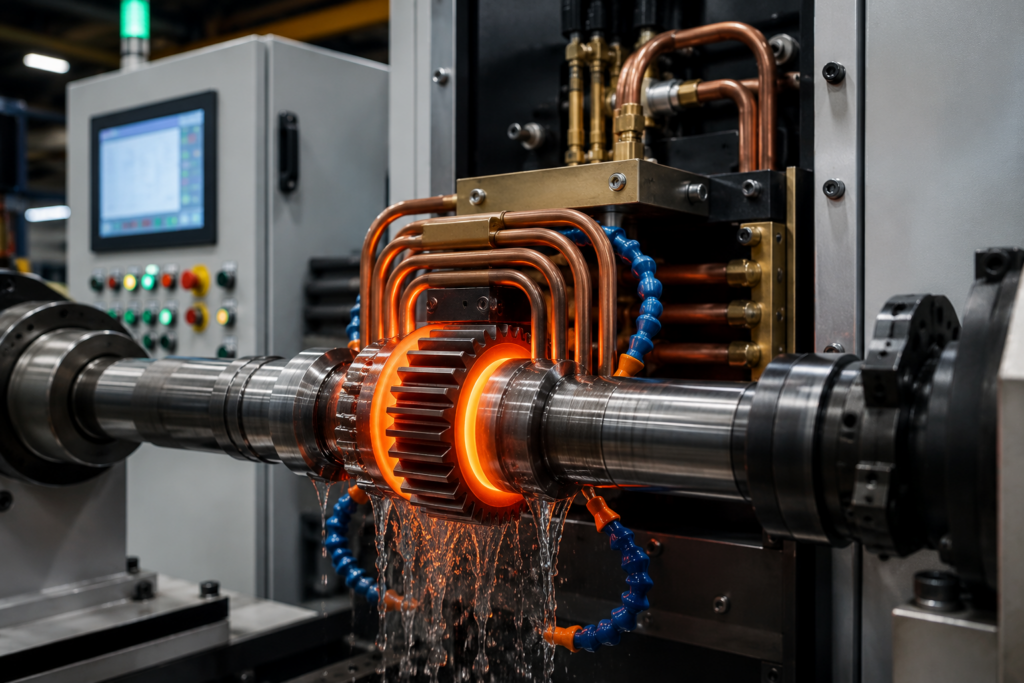
What Is an Induction Hardening Machine?
An induction hardening machine is a specialized piece of industrial equipment that uses electromagnetic induction to selectively heat the surface of a metal component to its austenitizing temperature, followed by controlled quenching to create a hard, wear-resistant surface layer.
A complete induction hardening machine system consists of:
- Power Supply (Converter Unit)— Converts mains electricity to the required high-frequency AC current
- Induction Coil (Inductor)— Transfers electromagnetic energy to the component
- Machine Frame & Motion System— Positions and moves the component during heating
- Quench System— Delivers the quenching fluid at the right time, flow rate, and position
- CNC/PLC Control System— Controls all process parameters and monitors quality
- Workholding & Fixturing— Holds the component in the correct position relative to the coil
All these elements must be matched to your specific application. Let’s explore each one.
Step 1: Define Your Application Requirements
Before evaluating any machine, you must clearly define:
Component Details
- What is the component? (e.g., crankshaft, gear, shaft, bearing race)
- What material/steel grade?
- What are the dimensions and weight?
- Which specific zones need to be hardened?
Process Targets
- Required case depth:5 mm? 2 mm? 5 mm? This directly determines frequency selection.
- Required hardness:Typically 58–65 HRC for most applications.
- Allowed distortion:Tighter tolerances require more controlled heating and quenching.
- Metallurgical requirements:Any microstructure specification (e.g., martensite only, no retained austenite > X%)?
Production Requirements
- How many parts per day/hour? This determines cycle time requirements.
- Is this a dedicated line (single part type) or flexible cell (multiple part types)?
- Manual, semi-automatic, or fully automatic loading?
Answering these questions upfront will filter out many unsuitable options and help your supplier design the right machine. IEI’s lab test and pre-design service can help you validate these parameters before committing to a machine purchase.
Step 2: Understand the Types of Induction Hardening Machines
Vertical CNC Induction Hardening Machine
The most common configuration for shafts, axles, spindles, and similar components. The workpiece rotates on a vertical axis while the induction coil scans along the part — or uses single-shot heating for specific zones.
Best for: Axle shafts, crankshafts (pin hardening), steering racks, spindles, tool shanks
Key features to look for:
- CNC servo-controlled vertical axis movement
- Programmable scan speed, power, and dwell time
- Integral quench ring
- Part rotation speed control
IEI offers a complete range of CNC vertical induction hardening machines from single-station to fully automated multi-station cells.
Horizontal CNC Induction Hardening Machine
Similar capability to vertical machines but oriented horizontally — better suited for long shafts or components that are difficult to handle vertically.
Best for: Long shafts, camshafts (horizontal scanning), large crankshafts
Multi-Inductor / Multi-Shot Machine
A machine equipped with multiple induction coils that can harden multiple zones of a component simultaneously — or in rapid sequence without repositioning.
Best for: Camshafts (multiple lobes), crankshafts (multiple journals), gear shafts (multiple journals + shaft body)
Advantage: Dramatically reduces cycle time compared to single-coil sequential hardening.
IEI’s Multi Inductor Induction Hardening Machine is specifically engineered for camshaft and crankshaft applications — hardening all journals simultaneously for maximum throughput.
Contour Hardening Machine (for Gears)
A specialized machine that hardens the contour of gear teeth — following the tooth profile to achieve uniform case depth along the flank, root, and tip. This is the most technically demanding form of induction hardening.
Best for: Automotive transmission gears, ring gears, sprockets
Requires: Precisely designed contour coils and sophisticated CNC motion control.
Billet/Bar Heating Machine
While not strictly a hardening machine, induction billet heaters are used to uniformly heat steel billets or bars before forging, rolling, or extrusion. IEI also offers billet heating solutions.
Step 3: Choose the Right Power Supply
The induction power supply is the heart of the hardening system. It determines the frequency, power output, and energy efficiency of your process.
Key Parameters:
Frequency
This is the most critical selection criterion — it directly determines case depth:
| Frequency Range | Typical Case Depth | Typical Applications |
| 500 Hz – 3 kHz | 4–10 mm | Large shafts, large gears, rail components |
| 3 kHz – 10 kHz | 2–5 mm | Crankshafts, medium shafts, large gears |
| 10 kHz – 30 kHz | 1–3 mm | Camshafts, medium gears, CV joint races |
| 30 kHz – 100 kHz | 0.5–2 mm | Steering rack teeth, small gears, valve stems |
| 100 kHz – 500 kHz | 0.1–1 mm | Small components, thin case requirements |
Power Output
Power determines how fast the component reaches austenitizing temperature. Higher power = faster heating = more controlled process for surface-only heating (less time for heat to conduct into the core).
For small components: 15–50 kW
For medium shafts and gears: 50–300 kW
For large components (crankshafts, wind turbine shafts): 300 kW–3,000 kW
IGBT vs Transistor Technology
Modern induction power supplies use IGBT (Insulated Gate Bipolar Transistor) inverter technology — offering:
- Precise frequency control
- Fast power response
- High energy efficiency (>93%)
- Longer service life vs older vacuum tube or SCR designs
- Industry 4.0 connectivity
IEI’s advanced IGBT power supplies cover power ranges from 25 kW to 3,000 kW, with frequency ranges to suit any application.
Variable Frequency (Dual Frequency / Simultaneous Dual Frequency)
Advanced power supplies can operate at two frequencies simultaneously — used for gear tooth contour hardening where you need to heat both the flank and root simultaneously without overheating. This is a premium feature for demanding gear applications.
Step 4: Custom Induction Coil Design
The induction coil (inductor) is arguably the most critical component in the system. A poorly designed coil produces soft spots, non-uniform case depths, and excessive distortion — regardless of how good the rest of the machine is.
The coil must be designed for your specific component geometry, material, case depth target, and heating mode (single-shot or scanning).
Key coil design considerations:
- Coil-to-part gap (coupling distance) — affects power transfer efficiency
- Number of coil turns — affects inductance and frequency matching
- Coil geometry — must match the component contour for uniform heating
- Quench integration — many coils have integral quench holes for immediate after-quench
- Material and coating — high-conductivity copper, brazed construction, ceramic or epoxy coating
IEI designs and manufactures all coils in-house at their Pune facility. They also offer 3D-printed copper coils using advanced additive manufacturing — enabling highly complex internal cooling passages and geometries that are impossible with traditional brazing. Visit the Custom Induction Coils page to learn more.
Step 5: Quench System Selection
The quench system is responsible for cooling the heated surface fast enough to form martensite — the hard phase required. The quench medium, delivery method, and timing all affect final hardness and distortion.
Common quench media:
- Water:Fast quench, high hardness, higher distortion and cracking risk
- Polymer (PAG) solution:Controlled quench rate, less distortion, widely used in automotive
- Oil:Slower quench, lower distortion, used for sensitive grades
- Air/gas quench:Very slow, used only for highly hardenable steels
Quench delivery methods:
- Integral spray quench in coil:Immediate quench through holes in the coil — used in scanning mode
- Follow quench ring:A separate ring sprays quench fluid immediately behind the coil
- Plunge quench:The entire component is plunged into a quench tank after heating — used for single-shot processes
Step 6: Automation and Industry 4.0 Integration
For high-volume production, machine automation is not optional — it’s essential. Consider:
- Robotic loading/unloading— 6-axis robots for fast, precise part handling
- Conveyor-based cell— for high-volume in-line production
- Part marking— laser or dot-peen marking for 100% traceability
- Vision systems— for coil gap verification and part orientation detection
- Real-time process data logging— temperature, power, time, quench flow rate for every part
- SPC integration— connecting to MES/SCADA for Statistical Process Control
- Predictive maintenance alerts— monitoring coil condition, power supply parameters, quench flow
IEI’s machines support full Industry 4.0 integration — from real-time dashboards to remote diagnostics and OEE reporting.
Step 7: Evaluate the Supplier — Key Questions to Ask
Not all induction hardening machine manufacturers are equal. When evaluating suppliers, ask:
- Do they have application expertise in your specific component?Ask for references.
- Do they offer lab testing / process validation?(IEI does — pre-design lab)
- Do they design their own coils?Generic coils won’t optimize your process.
- What is their power supply technology?Modern IGBT is essential.
- What is their local service capability?Spare parts, field engineers, remote diagnostics.
- What warranty and SLA do they offer for production uptime?
- Are they aligned with global technology leaders?(IEI = SAET SpA Italy / Ajax Tocco Magnethermic)
- Do they support Industry 4.0 / IATF 16949 requirements?
Total Cost of Ownership: What to Budget For
When evaluating induction hardening machine price, look beyond the initial purchase price to total cost of ownership (TCO):
| Cost Element | Notes |
| Machine capital cost | Varies widely by size and automation level |
| Coil set (tooling) | Separate cost; budget for spares |
| Installation & commissioning | 5–10% of machine cost |
| Training | Usually included by IEI |
| Energy cost | Induction is very efficient vs furnace |
| Quenchant cost | Polymer solution requires maintenance |
| Spare parts | Annual budget ~2–3% of machine cost |
| Service contract | Recommended for 24/7 production |
IEI provides transparent, application-specific quotations. [Request a Quote →](https://inductionindia.com/contact-us/)
Why IEI Is India’s Top Induction Hardening Machine Manufacturer
[Induction Equipment India Pvt. Ltd. (IEI)](https://inductionindia.com/), based in Pune, is India’s most trusted manufacturer and supplier of induction hardening machines — backed by the global expertise of SAET SpA Italy, a Group Company of Ajax Tocco Magnethermic Corporation, USA — with over 60 years of global experience and 4,000+ installations across 50+ countries.
IEI delivers:
- Machines engineered and manufactured in India (Indian power supply compatibility, local spare parts)
- Global technology and process expertise from SAET/Ajax Tocco
- Complete in-house capability: machines, coils, power supplies, automation
- Pre-purchase lab validation
- Full IATF 16949 process support
- Comprehensive aftermarket support across India
Serving industries from automotive and wind energy to aerospace and construction, IEI is the partner of choice for precision induction heat treatment in India.
Frequently Asked Questions
Q: What is the typical induction hardening machine price in India?
A: Machine prices vary significantly based on power output, automation level, and complexity. Contact IEI for an application-specific quotation.
Q: How long does installation and commissioning take?
A: Typically 2–5 days for machine installation, plus process validation and operator training.
Q: Can IEI retrofit or upgrade my existing induction hardening machine?
A: Yes. IEI’s aftermarket services include power supply upgrades, coil redesign, control system modernization, and full machine refurbishment.
Q: Does IEI export induction hardening machines?
A: Yes. IEI supplies machines across South Asia and other markets through the global SAET network.
Q: What is the typical machine lead time?
A: Standard models: 16–20 weeks. Custom-engineered solutions: 24–40 weeks from confirmed order.
Ready to Find Your Ideal Induction Hardening Machine?
The right induction hardening machine will be a competitive advantage for your manufacturing operation for 15–25 years. Don’t make this decision based on price alone — make it based on process expertise, technology quality, and lifecycle support.
[Talk to IEI’s Engineering Team Today →](https://inductionindia.com/contact-us/)
We’ll help you select, engineer, and commission the perfect induction hardening solution