
Induction vs Flame vs Case Hardening: Complete Guide for Engineers & Manufacturers
Introduction to Induction vs Flame vs Case Hardening
In modern metallurgy and industrial manufacturing, selecting the right surface hardening technique can directly impact product performance, durability, and cost efficiency. Among the most widely used methods, the comparison of Induction vs Flame vs Case Hardening is one that engineers, plant managers, and manufacturers frequently evaluate.
Each method offers unique advantages in terms of hardness depth, process speed, cost, and suitability for different materials and geometries. However, choosing the wrong process can lead to premature wear, distortion, or unnecessary production costs.
This comprehensive guide explores all three techniques in detail, compares their capabilities, and helps you determine the best method for your specific application.
What is Surface Hardening?
Surface hardening is a metallurgical process designed to increase the hardness of a component’s outer layer while maintaining a tough and ductile core. This dual property ensures:
- High wear resistance
- Improved fatigue strength
- Resistance to impact and deformation
Surface hardening is especially important in components subjected to friction, stress, and cyclic loading, such as gears, shafts, bearings, and automotive parts.
Types of Surface Hardening Methods
The three most widely used techniques include:
- Induction Hardening
- Flame Hardening
- Case Hardening (Carburizing, Nitriding, Carbonitriding)
Each method differs in how heat is applied and how hardness is achieved.
1. Induction Hardening
What is Induction Hardening?
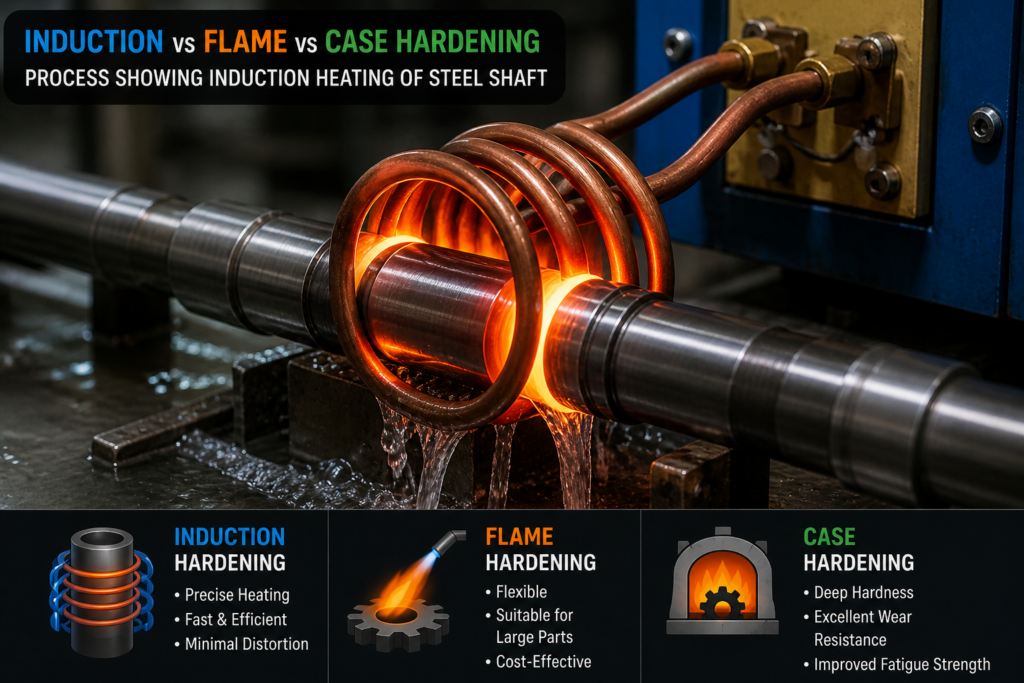
Induction hardening is an advanced heat treatment process that uses electromagnetic induction to heat the surface of a metal part rapidly. A high-frequency alternating current passes through a coil, generating eddy currents within the workpiece, which causes localized heating.
After reaching the desired temperature, the component is immediately quenched to lock in hardness.
Key Features
- Non-contact heating method
- Rapid heating and cooling cycles
- Precise control over case depth
- Highly repeatable results
Advantages of Induction Hardening
- Extremely fast process suitable for mass production
- Minimal distortion due to localized heating
- Clean and energy-efficient (no open flames)
- Easily automated with CNC and robotic systems
Limitations
- High initial equipment investment
- Requires conductive materials (mainly steel)
- Skilled setup and process control needed
Typical Applications
- Crankshafts and camshafts
- Gears and splines
- Bearings and shafts
- Automotive and industrial components
2. Flame Hardening
What is Flame Hardening?
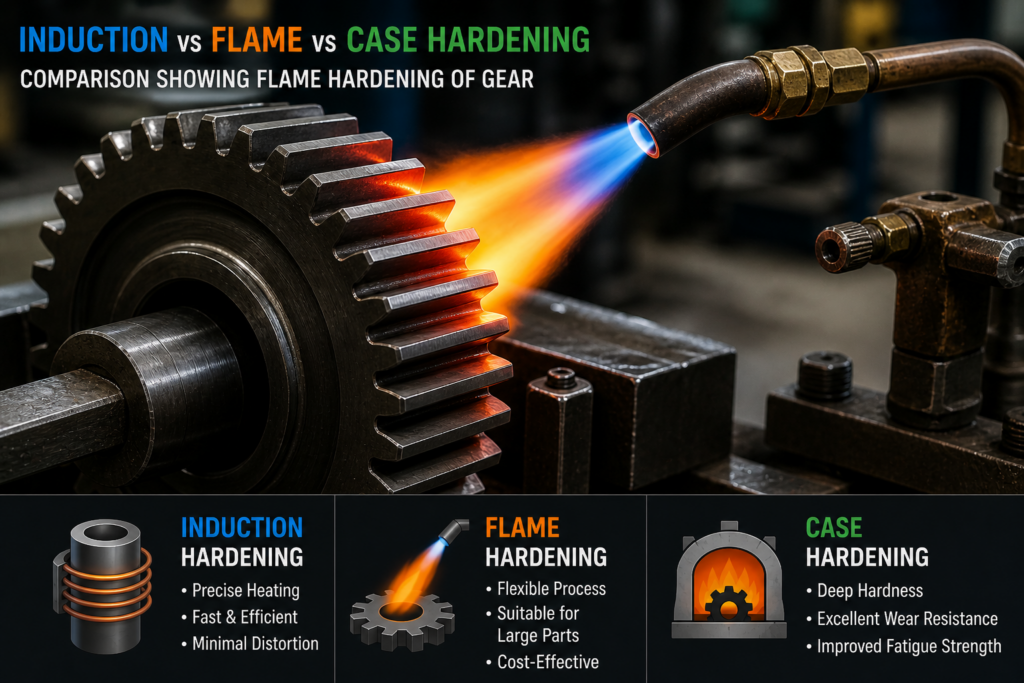
Flame hardening is a traditional method that uses an oxy-fuel flame to heat the surface of a metal component. Once the desired temperature is reached, the material is rapidly quenched to achieve hardness.
Key Features
- Uses oxy-acetylene or oxy-propane flame
- Direct heating of selected areas
- Can be manual or semi-automated
Advantages of Flame Hardening
- Lower equipment cost compared to induction
- Ideal for large or heavy components
- Flexible and portable setup
- Suitable for localized hardening
Limitations
- Less precise than induction hardening
- Higher risk of distortion
- Oxidation and scaling may occur
- Slower process
Typical Applications
- Large gears
- Machine beds
- Rail tracks
- Heavy-duty rollers
3. Case Hardening
What is Case Hardening?
Case hardening is a thermochemical process that alters the chemical composition of the metal surface by diffusing carbon or nitrogen into it. This creates a hard outer layer while maintaining a soft core.
Case Carburizing
What is Carburizing?
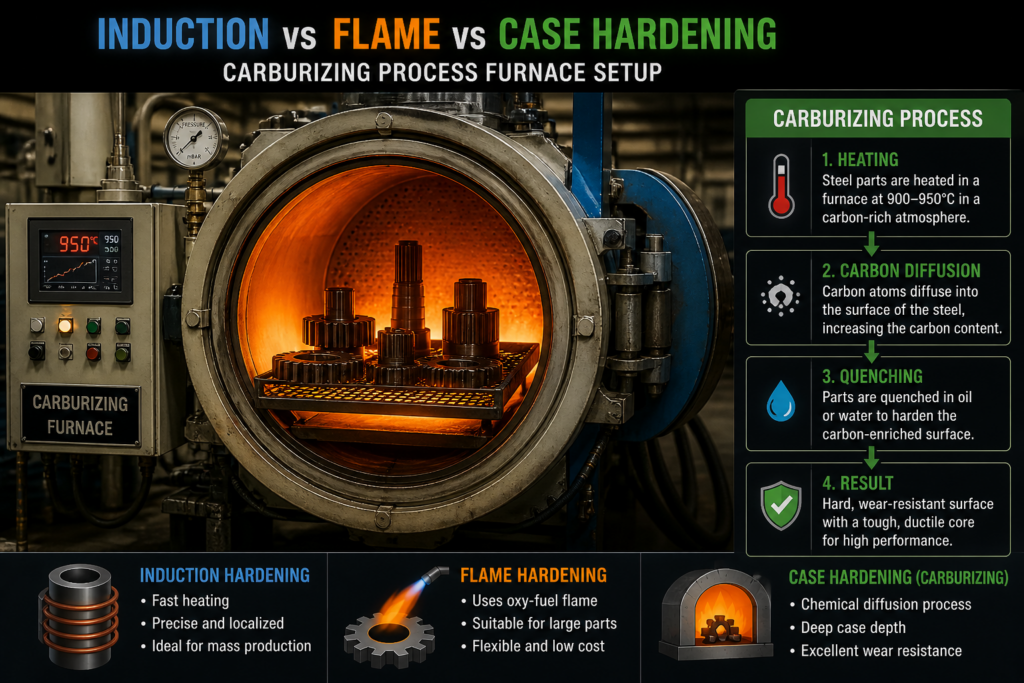
Carburizing is a case hardening process in which carbon is introduced into the surface of low-carbon steel at high temperatures in a carbon-rich environment.
Process Overview
- Steel is heated in a furnace (900–950°C)
- Carbon diffuses into the surface
- Part is quenched to harden the outer layer
Advantages of Carburizing
- Deep case depth (up to several mm)
- Excellent wear resistance
- Improved fatigue strength
- Ideal for heavy-duty applications
Limitations
- Long cycle times
- Requires post-quenching
- Higher distortion risk
Applications
- Automotive gears
- Transmission components
- Heavy machinery parts
Nitriding Process
What is Nitriding?
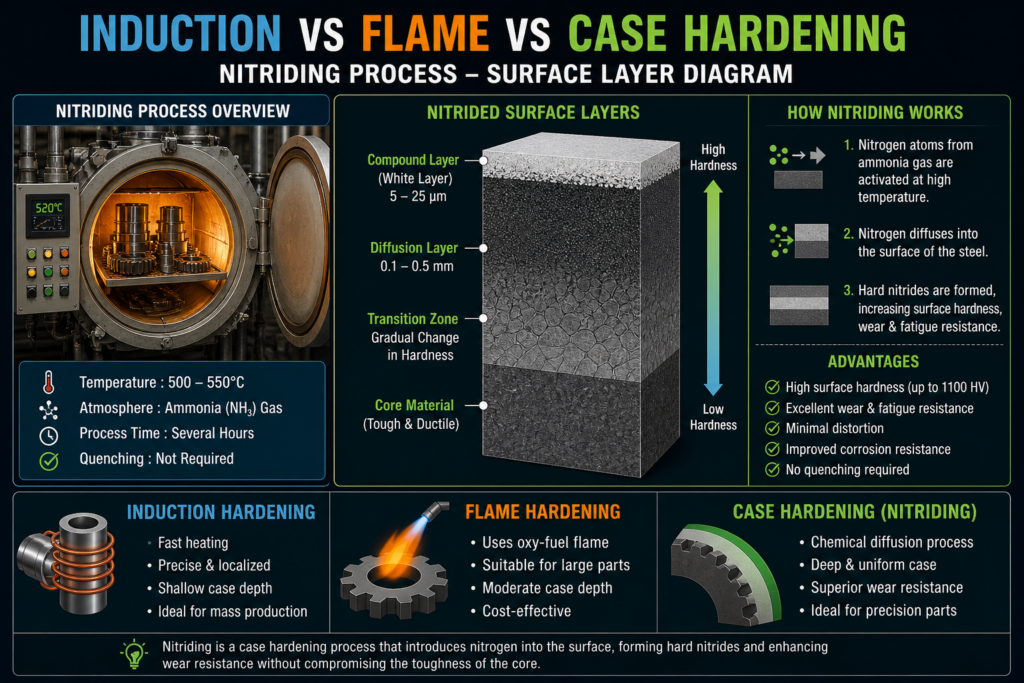
Nitriding is a low-temperature case hardening process where nitrogen is diffused into the metal surface using ammonia gas.
Process Overview
- Performed at 500–550°C
- No quenching required
- Forms hard nitrides on surface
Advantages of Nitriding
- Minimal distortion
- High surface hardness
- Excellent wear and corrosion resistance
- No post-treatment required
Limitations
- Slower process
- Limited case depth
- Requires alloy steels
Applications
- Aerospace components
- Dies and molds
- High-precision gears
Induction vs Flame vs Case Hardening
| Feature | Induction Hardening | Flame Hardening | Case Hardening |
|---|---|---|---|
| Heat Source | Electromagnetic induction | Oxy-fuel flame | Furnace + chemical diffusion |
| Hardening Depth | 0.5 – 5 mm | 1 – 6 mm | 0.2 – 2 mm (can be deeper) |
| Speed | Very fast | Moderate | Slow |
| Precision | Very high | Medium | High |
| Distortion | Minimal | Moderate | Low |
| Automation | Fully automated | Semi/manual | Automated |
| Cost | High initial | Low equipment | High operational |
| Best Use | Mass production | Large parts | Deep wear resistance |
Key Differences Explained
1. Heating Method
- Induction uses electromagnetic fields
- Flame uses direct combustion
- Case hardening uses chemical diffusion
2. Speed & Efficiency
- Induction is fastest
- Flame is moderate
- Case hardening is slow but thorough
3. Depth & Durability
- Case hardening provides the deepest and most durable layer
- Induction offers controlled depth
- Flame provides moderate depth
Choosing the Right Hardening Method
Choose Induction Hardening When:
- You need high precision
- Production volume is high
- Automation is required
- Minimal distortion is critical
Choose Flame Hardening When:
- Parts are large or irregular
- Budget is limited
- Production volume is low
Choose Case Hardening When:
- Deep hardness is required
- Components face extreme wear
- Material is low-carbon steel
Conclusion
When comparing Induction vs Flame vs Case Hardening, there is no one-size-fits-all solution. Each method excels in specific scenarios:
- Induction Hardening is best for precision, automation, and high-volume production
- Flame Hardening offers flexibility and affordability for large components
- Case Hardening delivers unmatched wear resistance and deep surface strength
By evaluating your production requirements, material type, and performance expectations, you can confidently choose the most effective hardening process.
For critical applications, consulting a heat treatment expert ensures optimal results and long-term component reliability.